.png)
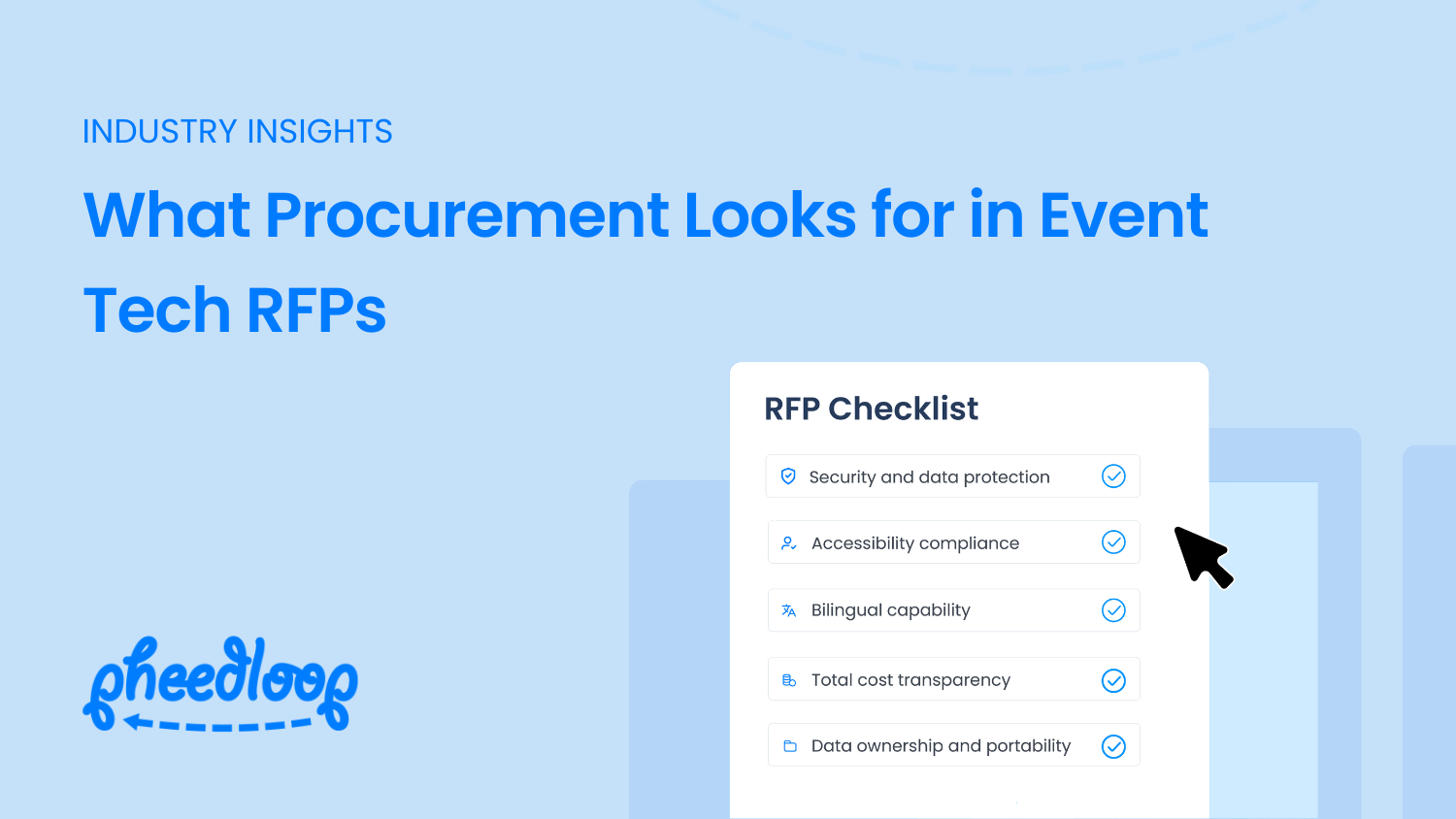
Procurement-driven event tech buying looks nothing like the discovery-call-to-demo motion most vendors are optimized for. A government agency, a university, or a healthcare association running a formal procurement starts by writing requirements, scores responses against those requirements, and only invites the top-scoring vendors to demo.
This means the demo is the last step of the evaluation, not the first. By the time you're in the room, the buyer has already filtered out vendors who couldn't pass the compliance bar in writing. Most event tech vendors aren't built for this motion. The ones who are tend to win their share of the deals that other vendors can't even compete for.
Whether you're a buyer writing a procurement-grade RFP for your next event platform, or a vendor trying to figure out what those RFPs are actually checking, here's what consistently shows up in the requirements.
1. Security and data protection
SOC 2 Type II certification is one common shorthand for vendor security maturity, but it's not what procurement actually evaluates against. The certification means an auditor evaluated controls across several categories over a period of time. Those categories are what procurement actually cares about. Knowing what's behind the badge is more useful than knowing whether the badge exists.
The capabilities worth evaluating any event tech vendor on:
- Access controls and authentication: role-based permissions, multi-factor authentication enforced for admin accounts, audit trails, employee offboarding procedures that revoke access quickly.
- Encryption: at rest (AES-256 or equivalent) and in transit (TLS 1.2 or higher), with proper key management and encrypted backups.
- Vulnerability management: regular scanning, documented patching cadence, coordinated disclosure with security researchers.
- Incident detection and response: monitoring for unusual access patterns, a defined response process, customer notification timelines written into the contract.
- Availability and disaster recovery: documented uptime commitment, geographically separated backups, defined recovery time and recovery point objectives.
- Data residency: physical location of data storage. Canadian government and provincially-funded institutions often require Canadian infrastructure, with documented proof of where servers are located. EU buyers ask similar questions about EU residency. US federal buyers add StateRAMP or FedRAMP requirements depending on the agency.
- Privacy and data handling: practices aligned with PIPEDA in Canada, GDPR for European data subjects, and applicable US state privacy laws. Healthcare-adjacent buyers add HIPAA. Buyers handling payment data add PCI-DSS.
The vendor who can walk through each of these categories specifically, with documented evidence, is the vendor procurement should move forward. The vendor who answers "we're SOC 2 compliant" without being able to discuss the underlying capabilities is the vendor who probably hasn't actually thought about them. Industry guidance on vendor security reviews takes the same position: the certification report is a starting point, not an endpoint.
PheedLoop angle: PheedLoop operates on AWS infrastructure, which holds SOC 2 Type II, ISO 27001, and other certifications, with Canadian data residency options for clients with explicit requirements. Our own operational practices follow SOC 2 guidelines across each of the categories listed above. We're happy to walk through how we handle each one on a security review call. We'll cover the broader data residency picture in an upcoming piece for Canadian government and education buyers.
2. Accessibility compliance
WCAG 2.1 AA is the floor, not the ceiling. Ontario buyers add AODA (Accessibility for Ontarians with Disabilities Act) compliance with documented testing evidence. US federal buyers require Section 508 conformance. European buyers reference EN 301 549.
What procurement actually checks: keyboard navigation through registration flows, screen reader compatibility on the event website and mobile app, color contrast ratios in the UI, text alternatives for all media, and accessibility statements published publicly.
Vendors who haven't built accessibility from the foundation can't easily retrofit it for a single RFP. The compliance score in the RFP is usually a leading indicator of how the platform was designed overall.
PheedLoop angle: The registration flow, event website builder, and mobile app are built to AODA and WCAG 2.1 AA standards from the foundation, with accessibility testing built into release cycles.
3. Bilingual capability
For Canadian federal departments and many provincial and university institutions, bilingual French and English is non-negotiable. This means more than a translated event website. It means registration forms in both languages, automated email confirmations in the registrant's chosen language, admin interfaces usable in either language, and live support staff who can respond in French.
US procurement is increasingly adding Spanish requirements for state and municipal agencies serving large Hispanic populations.
The depth of bilingual support is where most vendors fall short. A vendor whose UI is English-only with a Google Translate widget is not bilingual. A vendor whose registration form supports French but whose admin notifications only come in English is partially bilingual at best.
PheedLoop angle: PheedLoop's attendee-facing experiences (registration forms, event website, mobile app, automated email confirmations) support full bilingual workflows. The admin dashboard itself is English-only, which works for bilingual administrators but doesn't meet procurement requirements that mandate fully bilingual admin tooling.
4. Total cost transparency
Procurement responses require all-in pricing with no hidden fees. This means modular pricing has to be itemized in the response: base license, per-user costs, per-event power-ups, badge printing, on-site support, integration fees, and any payment processing service charges.
Vendors who quote a headline rate and then surface line items during contract negotiation get disqualified, often without being told why. Procurement teams have seen the pattern enough times to filter for it.
This is also where multi-year discount structures show up. Most RFPs ask for one-year, two-year, and three-year pricing side by side, and want to see the math on annual escalation clauses in writing.
We covered the structural side of event tech pricing in a previous piece on the five pricing models you'll encounter.
5. Data ownership and portability
What happens to the data when the contract ends? Procurement responses are checked carefully on this. Buyers want to see that registration data, member information, attendee engagement history, and any custom configuration can be exported in standard formats (CSV, JSON) with no extra fee, on a defined timeline, with documented migration support.
Vendors who keep data hostage to encourage renewal lose procurement contracts. Buyers have been burned before.
This also covers data deletion: what happens to historical data after the contract ends, how long it's retained, and what compliance with privacy laws (PIPEDA in Canada, GDPR for European data subjects, state privacy laws in the US) looks like for the offboarding process.
The pattern across all five
The thread running through procurement-driven evaluation is the same: buyers want documented, specific, in-writing answers. "We can support that" and "we're compliant with all major standards" aren't answers. The vendor who can walk through their security capabilities specifically, name their data center region, share an accessibility audit, demonstrate bilingual workflows on a live call, and itemize three-year pricing in writing is the vendor who survives the RFP filter.
If you're writing an event tech RFP for your next major event procurement, the categories above are the structure most procurement teams use. If you're a vendor responding to one, the questions in our longer piece on AMS integration evaluation cover one of the most common technical sections in detail.
The good news for procurement-driven buyers is that the vendors who can meet these requirements tend to be the ones building serious infrastructure. The bad news is that they're a smaller slice of the market than most evaluation grids suggest.

.png)
.png)
.png)